ai-generated-8672147_1280
CLIMATE CHANGE

How many species could go extinct from climate change? It depends on how hot it gets


Source: https://www.npr.org/transcripts/nx-s1-5218583

Scientists know climate change will cause extinctions, but just how many species might disappear in a warmer world has been harder to pin down. A new study out today tries to estimate how much of Earth’s biodiversity is threatened under different climate futures and which species are especially at risk.


earth
CLIMATE CHANGE

Climate change will soon make Earth’s days longer. Here’s what that means for the planet

Source: https://www.sciencefocus.com/planet-earth/climate-change-is-making-days-longer

Two recent studies have shown that global warming is changing things in ways we couldn’t imagine. The effects of climate change are pervasive, from biodiversity loss to extreme weather events, rising sea levels, wildfires and human mass migration. With each year that passes, we learn more about our impact on the environment – some of which are more surprising than others.

Joining the list is one of the most seismic findings to date: scientists have recently discovered that our greenhouse gas emissions are changing how Earth spins.


storm-4688918_1280
CLIMATE CHANGE

How Climate Change Affects Your Mental Health | Front Seat x Breathe Pakistan | Dawn News English

Source: https://youtu.be/0cXhF4R2sgE?si=_r3OlzGktzXhu2Pa

We’re kicking off a new season of Front Seat to Climate Change with Dawar Butt! This season, we’re proud to partner with Breathe Pakistan, Dawn Media’s climate change initiative, to bring you powerful conversations on tackling the climate crisis. In this episode, we’re joined by Dr Nausheen Anwer from Karachi Urban Lab, who shares her insights on how climate change affects your mental health. Don’t miss it!

dry-4282884_1280
CLIMATE CHANGE

Core Research Area Climate, Earth and Environment – Universität Hamburg

Source: https://www.uni-hamburg.de/en/forschung/forschungsprofil/klima-erde-umwelt.html

Which climate futures are possible, which are plausible? How probable is it that we can limit the warming of the Earth to 2 or, even better, 1.5 degrees Celsius? With its partners in the core research area Climate, Earth and Environment, Universität Hamburg is the only institution in Germany to investigate the cycle of climate change, the resulting changes in society, and the effects of those societal changes on climate.


flow
CLIMATE CHANGE

Movie Review: A wordless Latvian cat parable about climate change is the year’s best animated movie


Source: https://apnews.com/article/flow-animated-movie-review-98940a387edd5f83354719f51139bc33

In Gints Zilbalodis’ wondrously shimmering animated fable, a solitary black cat, after escaping a cataclysmic flood, navigates a water world. What brought things to this point is never explained. We’re left to look upon this strange, verdant and overgrown landscape through the amber eyes of our unnamed feline protagonist. Humans are completely absent, and it’s part of this beguilingly meditative film to wonder not just about what role we played in the flood, but to ponder the grace of the animal life left to inherit the Earth.

university-105709_1280
CLIMATE CHANGE

Campus networks speed up and scale up climate solutions

Source: https://www.universityworldnews.com/post.php?story=20241203185856507&utm_source=newsletter&utm_medium=email&utm_campaign=SDGNL9014

The higher education sector’s diverse strengths – including student activism, co-produced research, and sector-wide network mobilisation – are enhancing the speed and scale of climate solutions, according to a panel of experts at the recent session of the Conference of the Parties (COP29) of the United Nations Framework Convention on Climate Change (UNFCCC).

A roundtable session themed “Enhancing and enabling climate solutions with higher education” convened by the U7+ Alliance of World Universities, the University Climate Change Coalition and Second Nature, brought together faculty and centre leaders, including senior administrators and students from the Global North and South, to share examples and insights about how their learning institutions are leading climate change and sustainable development.

This followed the Network of Networks session, which gathered global higher education leaders to set priorities for the coming year and to explore ways to amplify their impact as non-state actors through the UNFCCC Marrakech Partnership and Global Climate Action Agenda.


climate
CLIMATE CHANGE

Building migrant- and refugee-inclusive health systems in a changing climate


Source: https://www.who.int/news/item/06-12-2024-building-migrant–and-refugee-inclusive-health-systems-in-a-changing-climate

As the world gathered at COP29 in Baku, Azerbaijan, the World Health Organization (WHO), in collaboration with the United Nations High Commissioner for Refugees (UNHCR), the International Organization for Migration (IOM) and the International Federation of Red Cross (IFRC), convened a pivotal high-level event to address the intersection of climate change, migration, displacement and health. 

COP29 brought attention to adaptation, loss and damage, emphasizing an inclusive process and outcomes. This includes integrating the health needs of migrants and refugees into national adaptation plans, scaling up investments in migrant-inclusive health systems and leveraging partnerships for community-centred solutions.

President Trump Holds Campaign Rally In New Hampshire
CLIMATE CHANGE

Urgent action is needed to curb Trump’s anti-climate agenda

Source: https://www.universityworldnews.com/post.php?story=2024120410193948&utm_source=newsletter&utm_medium=email&utm_campaign=SDGNL9014

The election of Donald Trump as United States president for the second time is the outcome that climate scientists feared. So what do we know about the policies that he will follow in this area? How will this affect climate scientists in the United States and globally? And how can his agenda be challenged?

Let’s start with a reminder of the urgency of the climate crisis. Global climate change is already reaching critical levels. Climate scientists estimate that global carbon emissions will likely exceed the level necessary to breach the 1.5°C temperature target – as specified in the Paris Climate Agreement – as early as 2027.


Untitled2
CLIMATE CHANGE

South Africa’s G20 presidency: An opportunity to address poverty and inequality

Source: https://news.cgtn.com/news/2024-11-30/S-Africa-s-G20-presidency-A-chance-to-address-poverty-inequality–1yWQAws5LDW/p.html

The developing world will close 2024 on a high when Brazil officially hands over its G20 Presidency to South Africa on December 2. As the country navigates through some serious economic challenges, Cyril Ramaphosa, its president, will have much to think about in terms of what exactly will be South Africa’s primary objectives as the incoming G20 President.

At this juncture, Ramaphosa’s presidency does not only speak for South Africa, but also represents the African continent as a whole. As the first African country to host the G20 Leader’s Summit next year, Ramaphosa will have his hands full in ensuring that the interests and concerns of the continent are adequately represented on the global stage.

As things stand, the global economy is facing numerous challenges, including inflation, climate change and inequality.

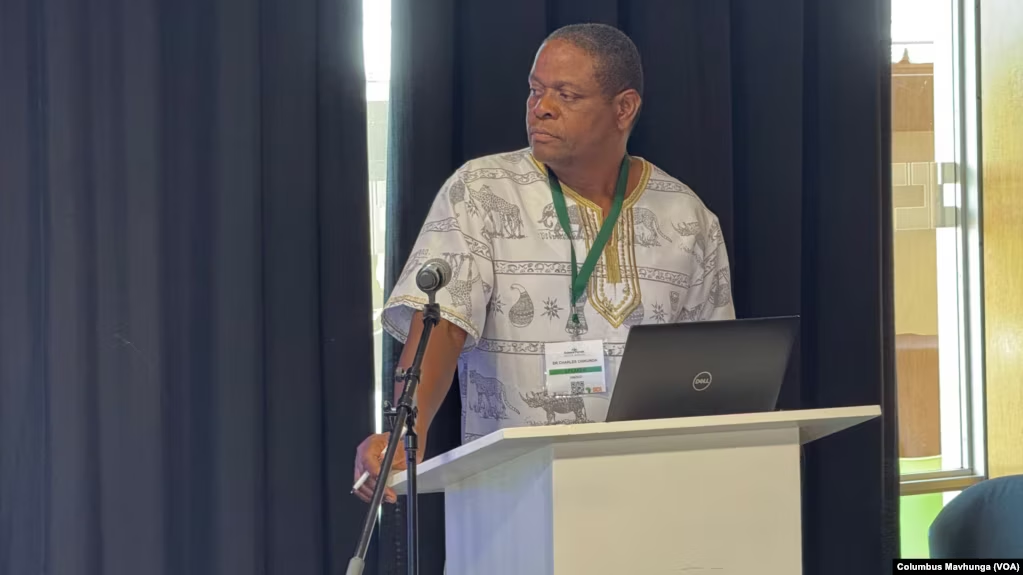
Charles Chikunda
CLIMATE CHANGE

UNESCO says education about climate change is essential in southern Africa

Source: https://www.voanews.com/a/unesco-says-education-about-climate-change-is-essential-in-southern-africa/7886128.html

The United Nations environmental agency UNESCO is calling for more studies and closer working relations between journalists and scientists to ensure the effects of climate change are understood and can be mitigated, especially in poorer African countries, which more acutely feel the pinch of extreme weather events.